
Deck Builderin San Bernardino, CA
A deck builder in San Bernardino must first ask whether the lot is in a foothill fire zone. The City's overlay bars exposed wood on exterior elements in Zones A and B, and the code does not say whether a deck counts. Only a detached deck of 200 square feet or less and 30 inches or lower skips a permit.
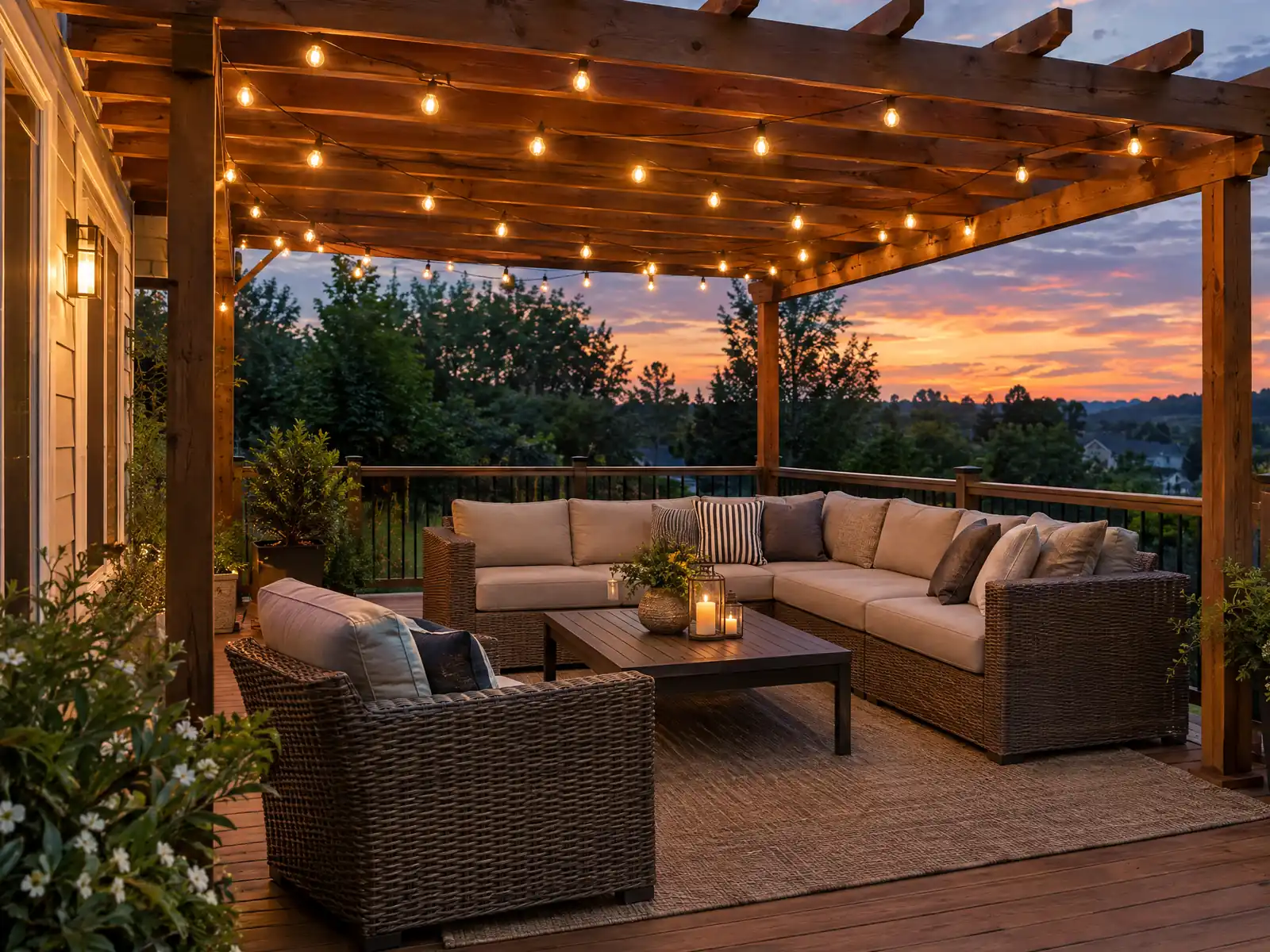
Decks here are mostly additions to postwar houses. The Census Bureau's 2024 estimates count 44,043 single-family detached homes, 64.2 percent of the city's 68,594 units, and 36.9 percent of all units went up before 1960, so a typical backyard deck is a retrofit on a tract house or an older deck whose boards, stairs and ledger need checking. The northern edge of the city climbs into the San Bernardino Mountains foothills, where fire overlays turn the choice of wood into a code question.
MDG Builders, CSLB #1040337, is a Tarzana general contractor. On a San Bernardino deck we draw the design, put the permit and fire-zone questions to the Building & Safety Division and hire a licensed carpentry subcontractor to build it. The decks page covers materials, the San Bernardino overview lists the rest of our trades in the city, and concrete work in San Bernardino covers the slab or footing side of a backyard.
What San Bernardino's Building & Safety Division, the County Fire District and state law say about decks
Where decks permits come from in San Bernardino: City of San Bernardino Community Development & Housing Department, Building & Safety Division.
- Decks: a deck is exempt from a building permit only if it is 200 square feet or less, not more than 30 inches above grade at any point, not attached to a dwelling and not serving an exit door; anything attached to the house, higher or larger needs a permit and is checked against zoning.
- Deck and patio structures in fire zones: the Foothill Fire Zones Overlay requires exterior elements, 'including walls, garage doors, fences, etc.', to be free of exposed wood in Zones A and B (and C where it abuts wildlands), and the Local Hazard Mitigation Plan says WUI construction must use fire-retardant or ignition-resistant materials at roofs, eaves, vents, walls, windows, doors and decks; the code text does not say whether a wood deck is an exterior element, so the Building Division should be asked before a wood deck or patio cover is designed on a foothill lot.
- Patio covers and gazebos are permitted accessory structures in the single-family zones (Table 04.01 lists Patio/Gazebo as permitted in RE, RL, RS and RU), but accessory structures need development review, are capped at 16 feet high and 50 percent of the main footprint, and in the rear setback may not project within 10 feet of the property line (19.20.030(17)).
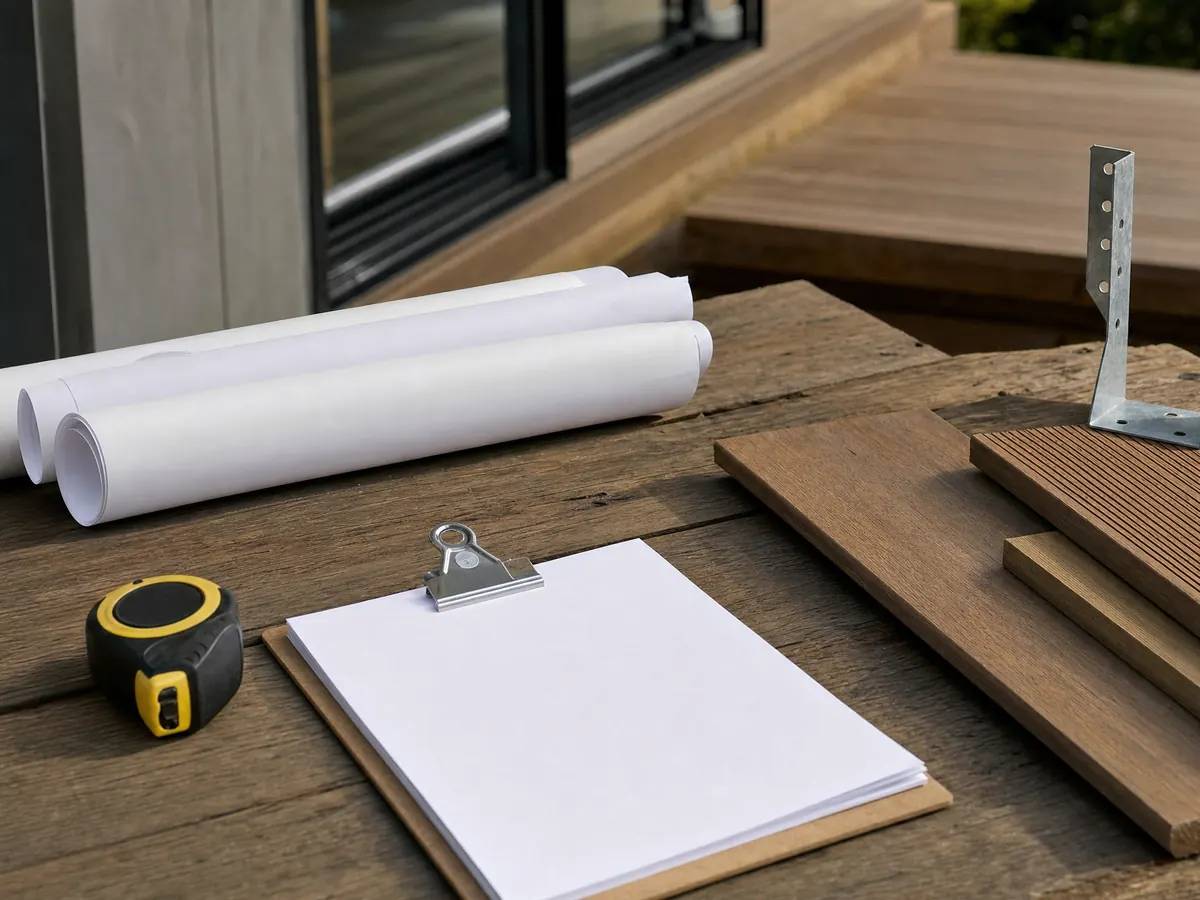
Does a deck in San Bernardino's foothill fire zones have to be free of exposed wood?
The code says exterior elements must be, and it does not say whether a deck is one. Development Code 19.15.040 requires exterior elements, including walls, garage doors and fences, to be free of exposed wood in Foothill Fire Zones A and B and in Zone C where it abuts wildlands. A wood deck is not named in the text we read, so ask the Building Division in writing before a wood deck or patio cover is designed on a foothill lot. The 2024 Local Hazard Mitigation Plan calls for fire-retardant or ignition-resistant materials at decks, roofs, walls and windows in the wildland-urban interface.
Two maps exist and they are not the same age. Municipal Code 15.10.030 uses a City map dated October 29, 2008 for Very High zones, while the San Bernardino County Fire District adopted Ordinance 4489 on June 10, 2025 for Moderate, High and Very High zones in its Local Responsibility Areas, and the pages we read do not say which City parcels fall in each. Since July 1, 2016 the District, not a City department, has provided fire protection here, and its fire hazard map page is where an address is checked.
The overlay also governs the yard around the deck: roadside vegetation cleared 10 feet from the curb, two private spigots facing the wildland, a 50 foot irrigated wet zone, thinning zones of at least 100 feet and 1,000 gallons per minute of fire flow. The Plan's fire history includes the 1980 Panorama Fire, with about 280 homes destroyed, and the 2003 Old Fire.
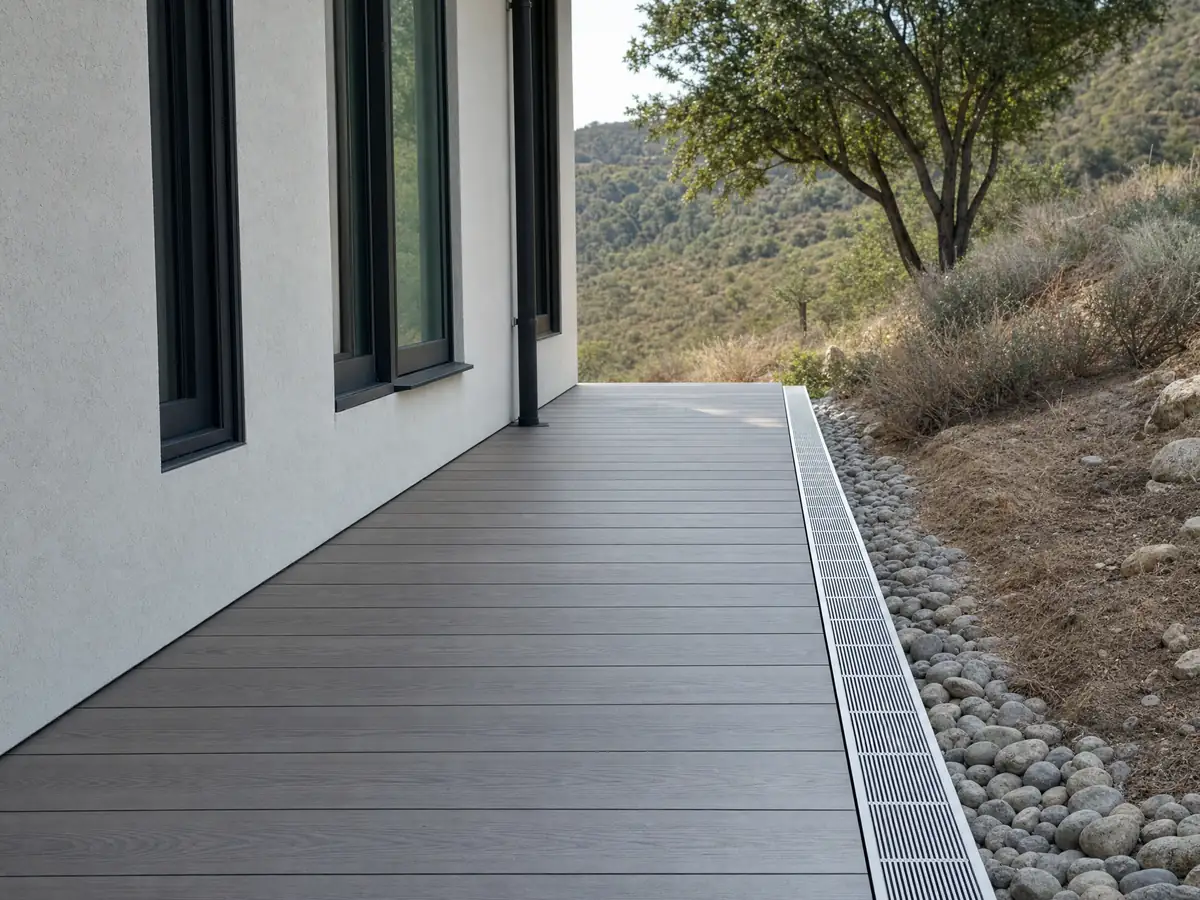
Do you need a permit to build a deck in San Bernardino?
Yes, unless the deck is small, low and free-standing. The City's exempt list covers a deck of 200 square feet or less that is not more than 30 inches above grade at any point, is not attached to a dwelling and does not serve an exit door. Anything attached to the house, higher or larger needs a permit and is checked against zoning.
Process matters more than the exemption. Plan check is in person at 201 North E Street, with three printed sets of plans at least 24 by 36 inches for a complex submittal and wet-stamped sheets when an architect or engineer prepares them, and the City says it does not accept plans by mail, courier or email. It publishes no plan-check turnaround, so ask the counter for the current wait. Inspections are requested through SB Direct at 909-998-2000.
Keep the permit alive. Municipal Code 15.04.050, read in GoCodebook's third-party copy, treats 180 days without an inspection and visible progress as evidence that work is abandoned and the permit expired, so a weekend build that stalls over a lumber delay needs an inspection booked in that window. An owner may pull the permit for a one- or two-family home if the owner lives there, does the work personally and signs the workers' compensation statement.
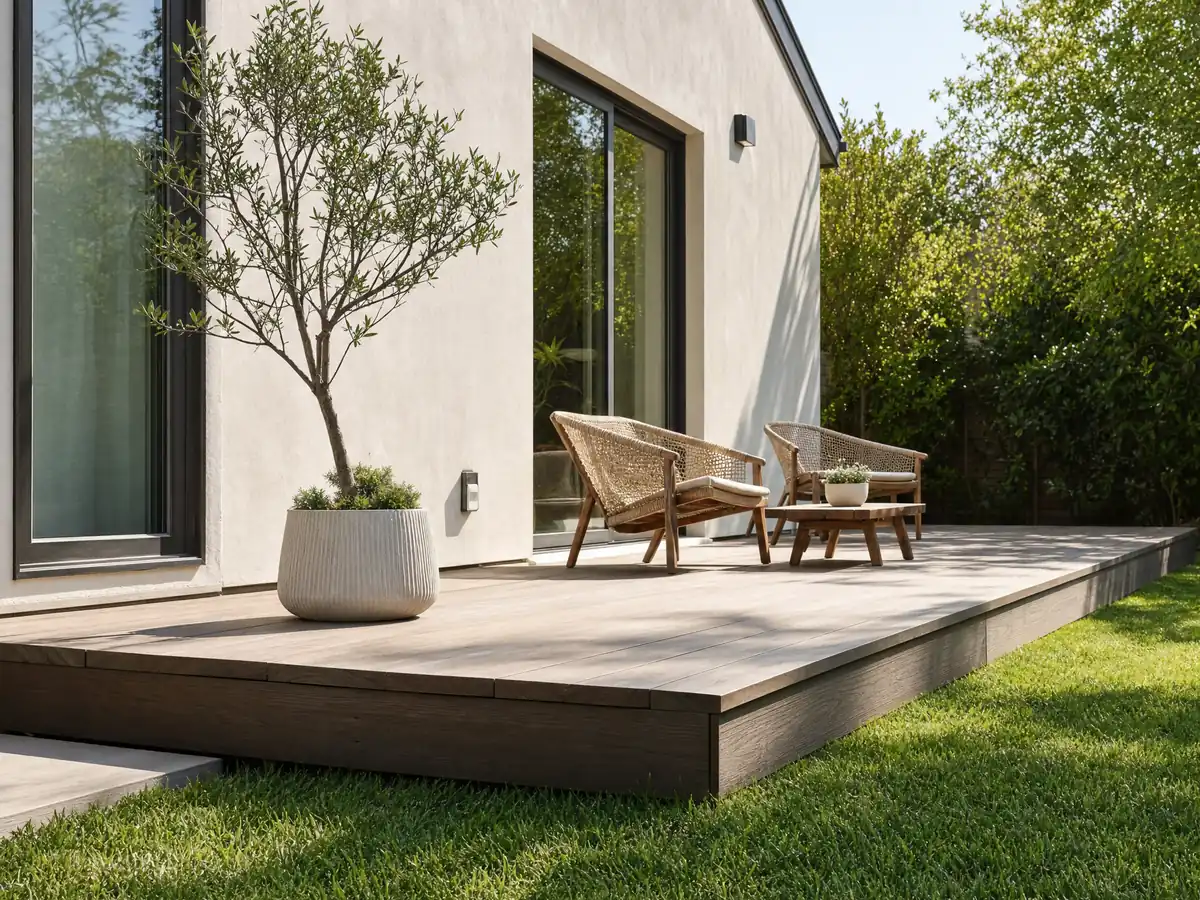
Can you do deck repair in San Bernardino without a permit, and when does it trigger a retrofit?
Swapping a few boards usually reads as maintenance, but nothing we found says so for decks, so ask. The City's exempt list has no repair line for decks, and the parts a plan checker cares about are structural ones such as ledgers, posts and stairs. Termites are the usual reason for repair: UC Integrated Pest Management says drywood termites are most common in southern California and do infest decks, and its advice is to fix moisture and seal exterior wood.
In the foothills, repair can reach the whole deck. The Development Code overlay says an element must be retrofitted when more than 25 percent of it is replaced and names roofing and fencing as examples, while Municipal Code 15.10.040 sets 60 percent for an element and 60 percent of replacement cost for the whole structure. The two chapters were read separately and disagree, and neither names a deck, so get the Building Division's answer in writing before replacing a third of the boards.
Rental owners should ask what an inspector can cite outdoors. The City estimates about 30 percent of its single-family homes are rentals inspected every other year, and its pages list no deck checklist.
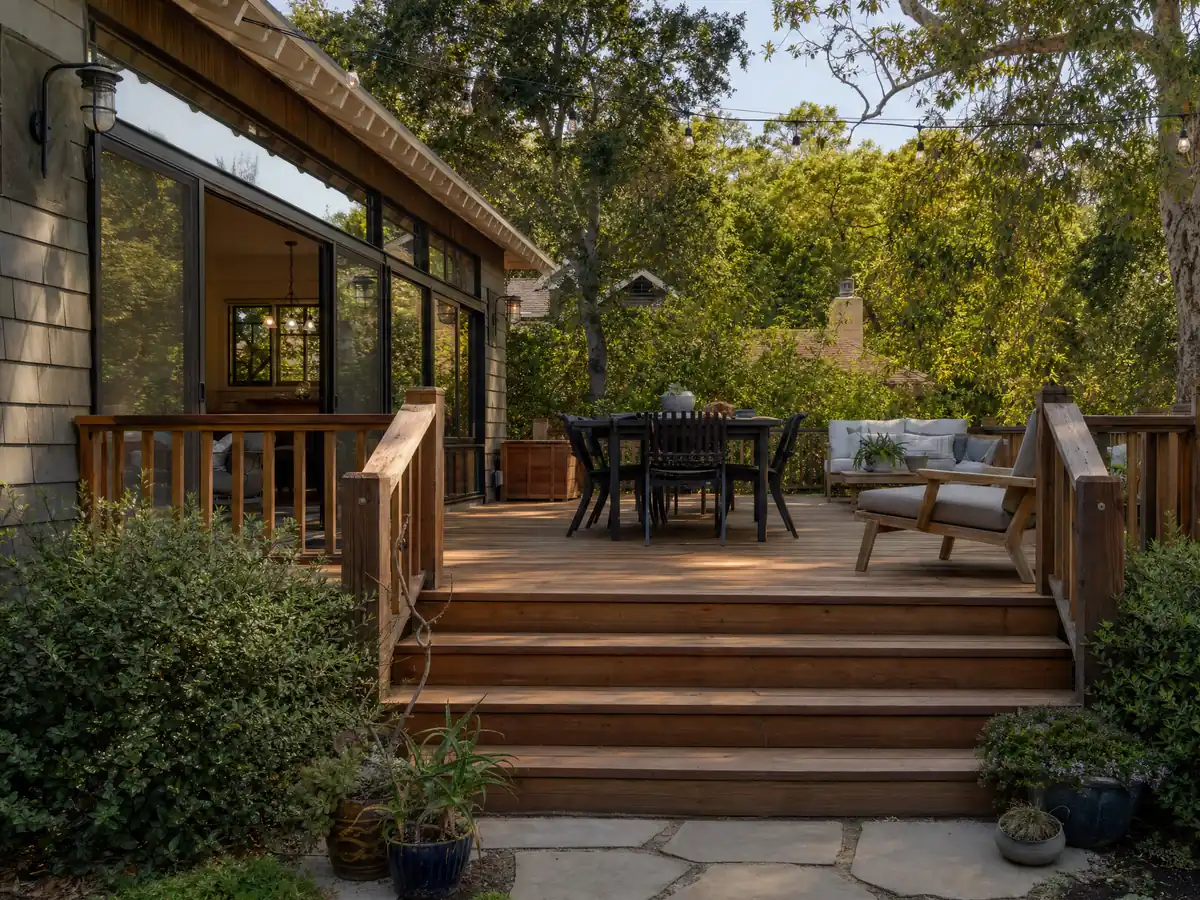
How high must a deck guard be, and what holds a San Bernardino deck to the house?
Guards are 42 inches in the California Residential Code, and they are required where the walking surface is more than 30 inches above grade within 36 inches of the edge. Section R312.1.1 sets the 30 inch trigger, R312.1.2 the 42 inch minimum and R312.1.3 requires openings that stop a 4 inch sphere. These numbers come from the 2022 edition, and the City adopted the 2025 codes in Municipal Code 15.04.020, so confirm they carried over.
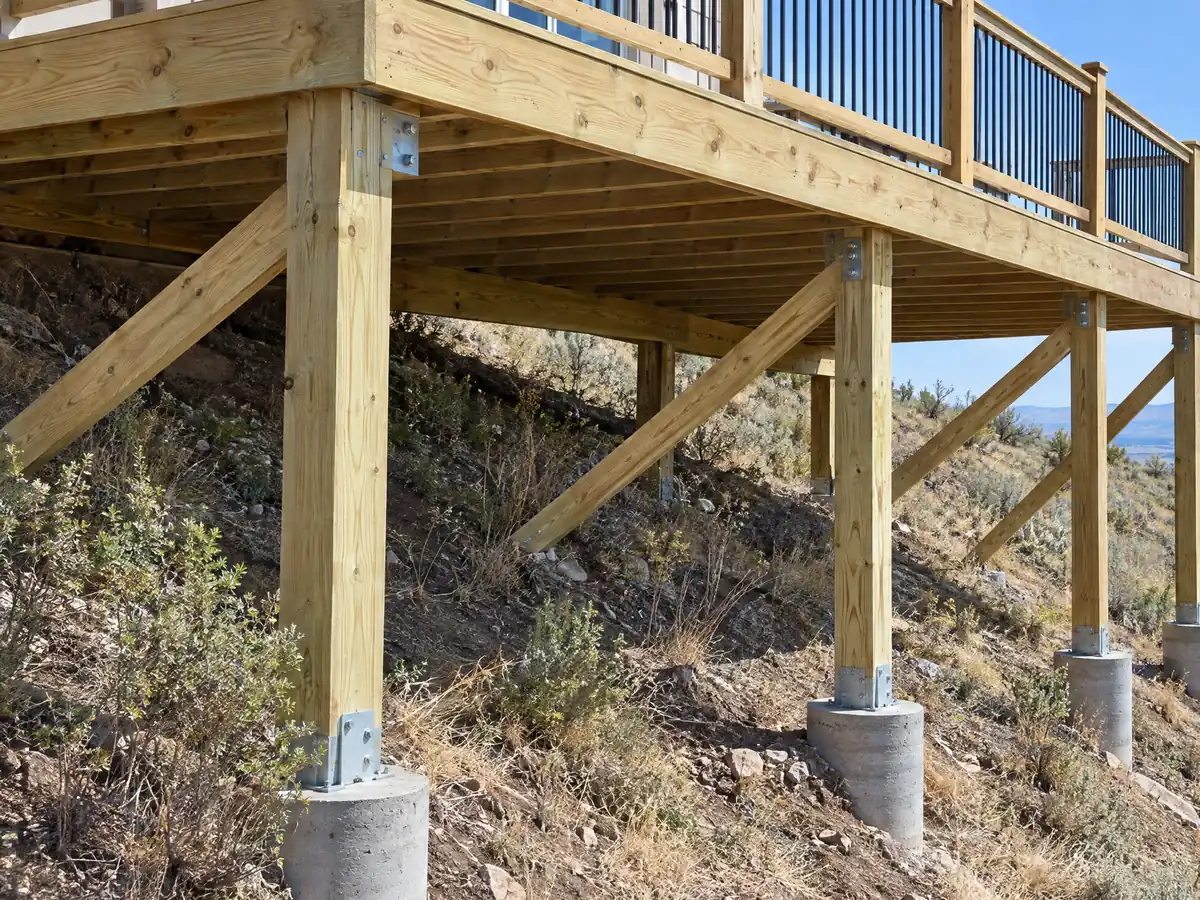
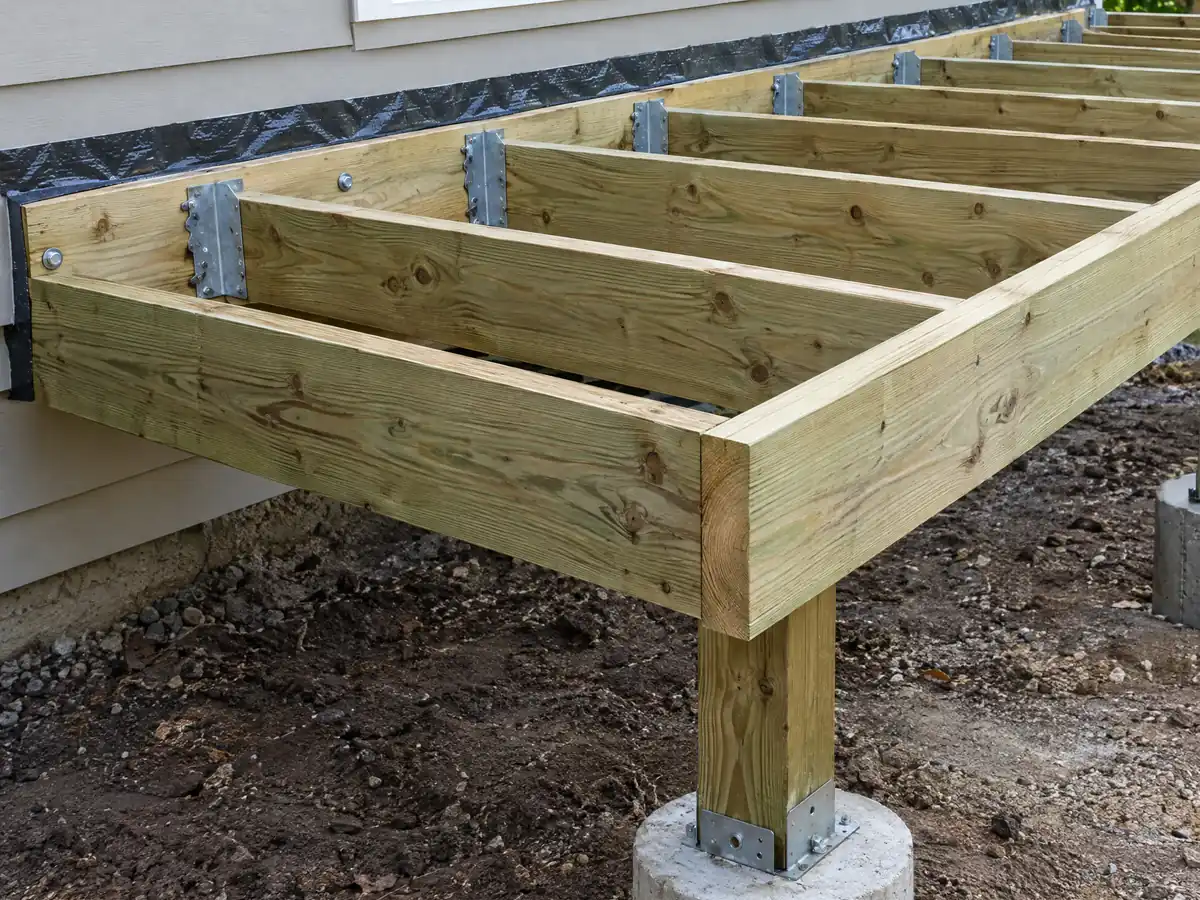
The ledger is where decks fail. R507.9.1.1 calls for a pressure-treated ledger of at least 2 by 8, no beam or girder loads on it and no attachment to stone or masonry veneer, and R507.9.1.3 wants hot-dip galvanized or stainless fasteners with the ledger flashed. For sideways loads, R507.9.2 asks for two 1,500-pound hold-downs within 24 inches of each end of the deck or four 750-pound devices. With two active faults in the city, those are the details to see drawn.
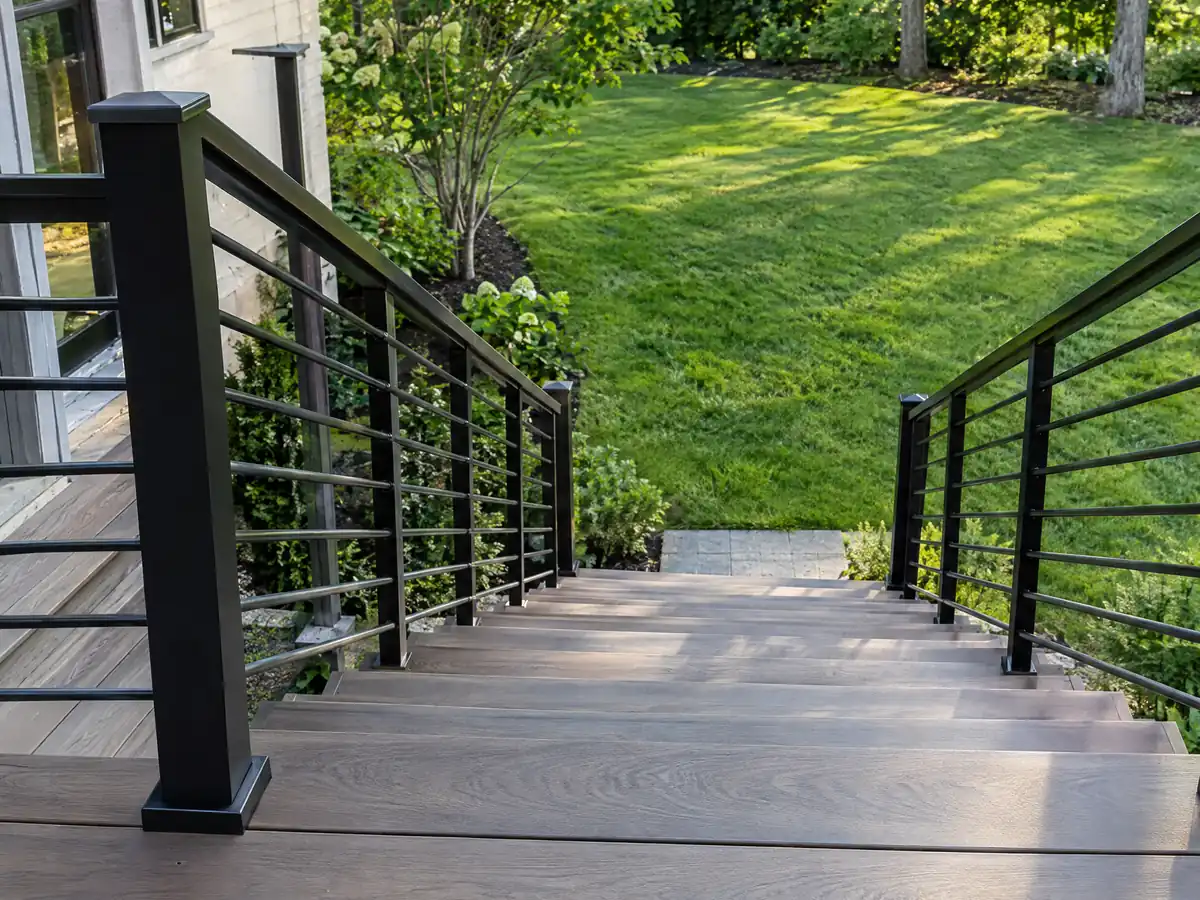
What do deck footings need on a San Bernardino slope, near a fault or over high groundwater?
Slope comes first. The Hillside Management overlay covers the 15 percent and steeper foothills and requires a Conditional Use Permit for most uses, Municipal Code 15.04.140 asks for a civil engineer's grading plan above 50 cubic yards, and the foothill overlay adds erosion and drainage plans by a licensed civil engineer for new projects. A deck on a steep lot starts with an engineer, not a lumber list.
Then the ground. Much of the city sits over the Bunker Hill Groundwater Basin, the Plan puts downtown in the high liquefaction susceptibility zone and nearly the entire southern part in a susceptible one, and both the San Andreas and San Jacinto faults have State Alquist-Priolo zones. Municipal Code 15.08 asks for liquefaction reports only for listed building types, and a deck is not among them, so ask whether a soils engineer's note on footing depth is wiser than guessing.
Where can a deck, patio cover or pergola go on a San Bernardino lot?
Patio covers and gazebos are permitted accessory structures in the RE, RL, RS and RU single-family zones, but accessory structures need development review and are capped at 16 feet high and 50 percent of the main structure's footprint. In the RS zone the residential table lists a 7,200 square foot minimum lot, a 25 foot front setback, 5 foot side setbacks, a 15 foot street-side setback and 35 percent lot coverage, while the rear setback cell is garbled in the City's PDF, so confirm it with Planning.
Rear yards allow some projections. Development Code 19.20 lets pools, patio covers, gazebos and awnings project into a rear setback only if nothing comes within 10 feet of the property line, and only roof overhangs, chimneys, awnings and canopies may project into front and side setbacks. The same code warns that the Building Code may demand more distance from lines and other structures, and the airport and flood overlays add their own limits, so ask Planning to check both.
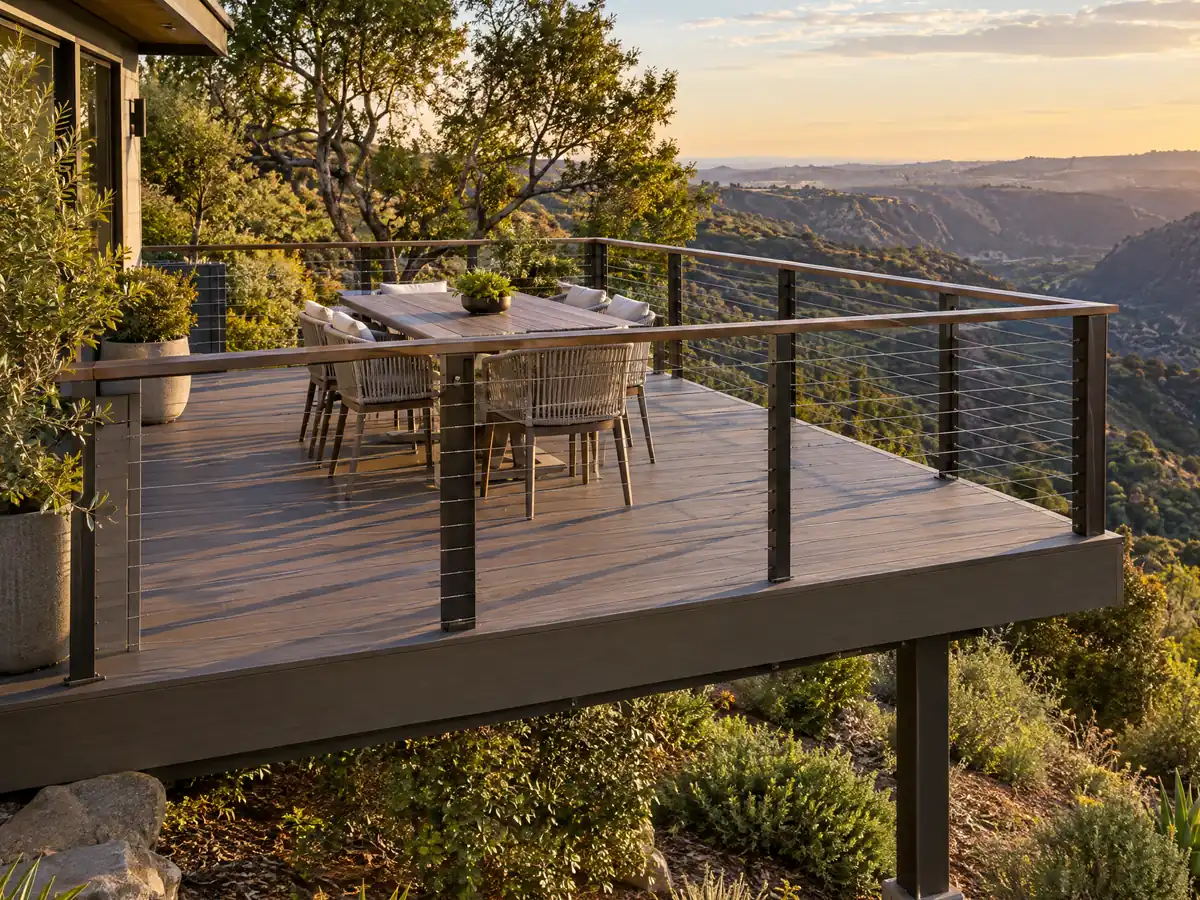
What does a deck builder charge in San Bernardino, wood or composite?
No San Bernardino deck price study with a stated method turned up, so the anchors are Los Angeles sources of medium confidence for wood and medium to low for composite. The 2025 Cost vs. Value report for Los Angeles prices a 16 by 20 deck with a built-in bench and planter, three steps and full railing at $18,419 in wood, recouping 99.6 percent at resale, and $26,872 in composite, recouping 73.9 percent. Angi's Los Angeles page, updated October 28, 2025, shows an average of $13,570 and $45 to $90 per square foot.
Our planning ranges for a standard attached deck on a flat lot are $45 to $75 per square foot for pressure-treated wood and $65 to $110 for composite, which puts a 16 by 20 at roughly $14,500 to $24,000 in wood and $21,000 to $35,000 in composite. Permits, engineering, soils work and fire plan review come extra, and hillside, second-story and exotic-wood decks are priced by site visit because no independent Los Angeles data covers them. Carpenters averaged $37.79 an hour in the Los Angeles metro area in May 2025.
CSLB's C-5 class covers form work, framing and rough carpentry for framed structures, and the pages we read do not say which class covers composite surfacing, so ask the subcontractor which license covers each part. Business and Professions Code 7159.5 caps the down payment at $1,000 or 10 percent, whichever is less.
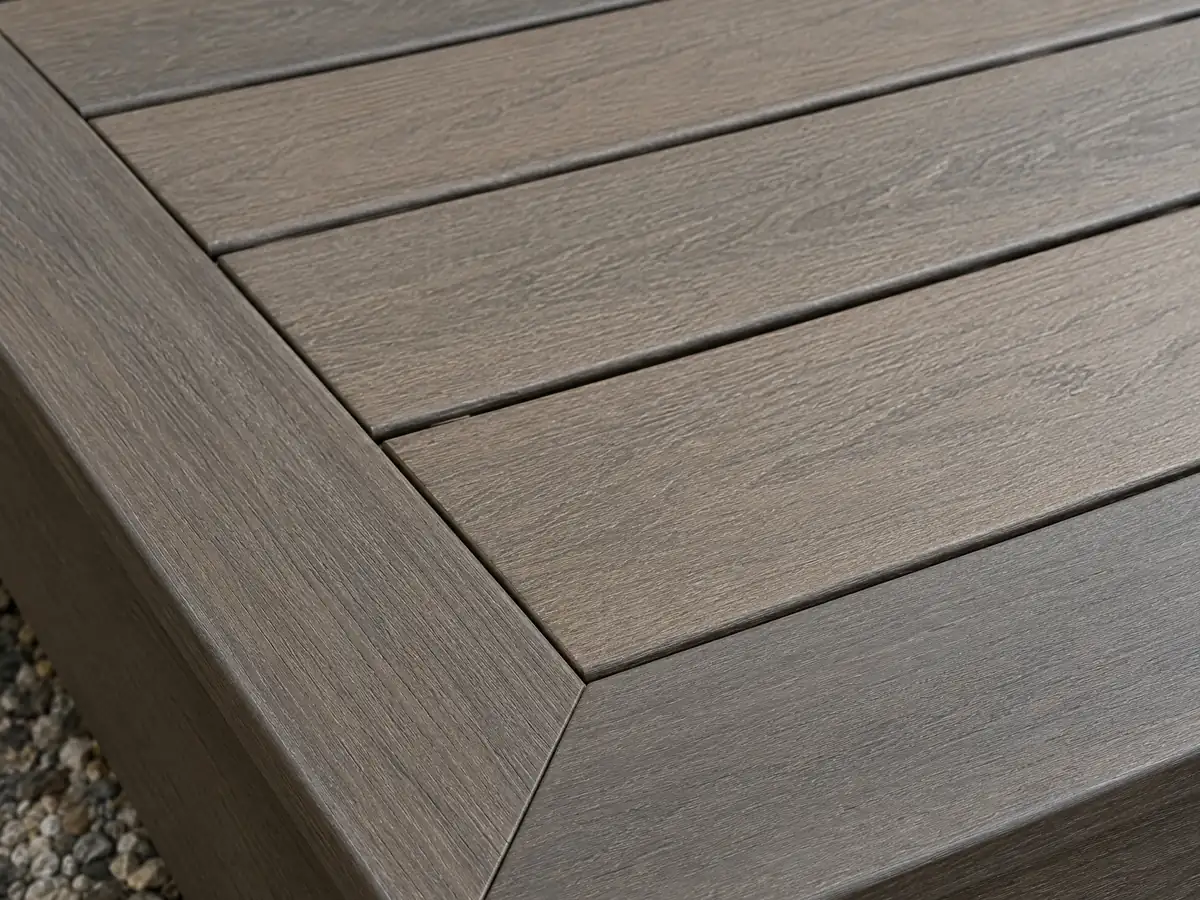
Deck photos from San Bernardino and nearby communities
Framing, footings, guards and finished decks from San Bernardino and the neighborhoods around it, shown at the steps where the rules matter. Tap any photo to enlarge it.
What decks costs around San Bernardino
Dollar figures on this page are Los Angeles planning ranges from our decks page, not a San Bernardino bid, and permits, engineering, soils work and any fire plan review belong on their own proposal lines. For nearby backyards, read decks in Riverside, decks in Corona and decks in Pomona, with decks in Los Angeles as the big-city benchmark. A deck often travels with flooring in San Bernardino. The subcontractor guide explains who frames and who finishes, and our license check guide shows how to read a CSLB record.
| What it covers | Typical range |
|---|---|
| Pressure-treated wood deck | $45 to $75 per square foot |
| Composite deck | $65 to $110 per square foot |
| 16 by 20 foot wood deck (320 sq ft) | About $14,500 to $24,000 |
| 16 by 20 foot composite deck | About $21,000 to $35,000 |
| Hillside, second-story, rooftop and ipe decks | Priced by site visit |
| Permits and engineering | Quoted as separate lines |
Other work we manage in San Bernardino
San Bernardino deck questions, answered
Do you need a permit to build a deck in San Bernardino?
Yes, unless the deck is 200 square feet or less, not more than 30 inches above grade at any point, not attached to a dwelling and not serving an exit door. Attached, higher or larger decks need a permit and are checked against zoning. Plan check is in person at the Building & Safety counter on North E Street.
Can a deck be built from wood in a San Bernardino foothill fire zone?
Ask first, because the answer is not written plainly. The foothill overlay bars exposed wood on exterior elements in Zones A and B, and in Zone C where it abuts wildlands, but its text does not say whether a deck counts. Get the Building Division's answer in writing and check the lot on the County Fire District's map.
Is railing height 36 or 42 for decks?
Forty-two inches under the California Residential Code, which requires a guard where the walking surface is more than 30 inches above grade within 36 inches of the edge. Openings must stop a 4 inch sphere. Those section numbers come from the 2022 code, and San Bernardino adopted the 2025 edition, so confirm them with the City.
Does a 3 foot high deck need a railing?
Yes. A walking surface more than 30 inches above grade within 36 inches of its edge needs a guard under the California Residential Code, and 3 feet is 36 inches. The guard must be at least 42 inches tall with openings that stop a 4 inch sphere. A 3 foot deck is also above the 30 inch permit exemption.
How much should a 16x20 deck cost?
The 2025 Cost vs. Value report for Los Angeles prices a 16 by 20 wood deck with bench, planter, steps and railing at $18,419 and a composite one at $26,872. Our planning ranges are about $14,500 to $24,000 in pressure-treated wood and $21,000 to $35,000 in composite, with permits and engineering extra.
Is it cheaper to build a wood deck or a composite deck?
Wood costs less to build. In the Los Angeles Cost vs. Value report a wood deck is $18,419 and recoups 99.6 percent at resale, while composite is $26,872 and recoups 73.9 percent. Composite saves on staining later, but in a San Bernardino foothill fire zone either material has to meet the fire rules.
Do I need a permit for deck repair in San Bernardino?
Ask before you start, because the City's exempt list has no deck repair line. Replacing a few boards is often maintenance, but ledgers, posts and stairs are structural. In foothill fire zones, replacing more than 25 percent of an element may trigger a retrofit under the Development Code, while the municipal code says 60 percent.
What happens if a deck is built without a permit?
We found no San Bernardino penalty schedule or after-the-fact permit page for decks, so ask the Building Division what it requires before you apply. Business and Professions Code 7048 never allows unlicensed work where a permit is required, so check the contractor's CSLB license first.
What license does a deck builder need in San Bernardino?
A deck builder needs a current California license, usually a general building license or C-5 framing and rough carpentry, plus a City of San Bernardino business license to pull permits. Check the number on the CSLB site and ask each subcontractor for a license and certificate of insurance.
Tell us the height, the slope and whether the lot is near the foothills
Say how high the deck will sit, whether the yard is flat or sloped, whether you live near the mountain edge of the city and whether this is new construction or a repair. The fire map, permit and soil questions come with us to the first visit.