
Composite vs. Wood Decking in California: Cost, Lifespan, Fire Rating and Heat
Wood is cheaper to build and composite is cheaper to keep. In Remodeling magazine's 2025 Cost vs. Value report for Los Angeles, the wood reference deck cost $18,419 and the composite one $26,872. Composite carries longer manufacturer warranties, both get hot in direct sun, and in wildfire zones either must be a tested or listed product.
Is composite decking worth the extra money over wood?
It depends on how long you plan to stay and how much sanding and sealing you are willing to do. Remodeling magazine's Cost vs. Value 2025 report for Los Angeles prices the same reference deck two ways. Built in wood it costs $18,419 and adds $18,341 at resale, a 99.6 percent return. Built in composite it costs $26,872 and adds $19,845, about 73.9 percent.
So the composite deck costs $26,872 - $18,419 = $8,453 more, and a buyer pays only $19,845 - $18,341 = $1,504 more for it. If you sell soon, wood wins on paper. If you stay, the question is what the wood deck costs in stain, sealer and board replacement, and nobody publishes an independent Los Angeles number for that.
Wood and composite deck costs in Los Angeles
The first four rows are one reference deck priced two ways by Cost vs. Value 2025. The remaining rows are Angi's Los Angeles survey ranges from October 2025, which cover decks of every size and design.
| What it covers | Typical range | What moves the price |
|---|---|---|
| Wood reference deck, 16 x 20 ft | $18,419 (about $58 per sq ft) | Pressure-treated frame and boards, stairs, railing, bench |
| Composite reference deck, 16 x 20 ft | $26,872 (about $84 per sq ft) | Same deck with composite boards and railing |
| Resale value, wood deck | $18,341 (99.6 percent recouped) | Survey of real estate professionals, Los Angeles |
| Resale value, composite deck | $19,845 (73.9 percent recouped) | Same survey |
| Any new deck, built | $45 to $90 per sq ft | Height, stairs, design, access, material |
| Pressure-treated boards, material only | $2 to $5 per sq ft | Grade and board size |
| Composite boards, material only | $12 to $22 per sq ft | Product line, color, capped or uncapped |
| Typical whole deck, any material | $6,335 to $20,871 (average $13,570) | Angi Los Angeles survey |
How we got these numbers: the Cost vs. Value 2025 report for Los Angeles from Remodeling magazine (Zonda, published in the Journal of Light Construction), which prices a fixed 16 by 20 foot deck and surveys real estate professionals on resale value, and Angi's Los Angeles deck cost page (updated October 28, 2025), built on surveys of its customers. Per-square-foot figures for the reference decks are our division of the totals by 320 square feet. Confidence is medium for wood and medium-low for composite. Permits and engineering are extra. MDG's written proposal for your deck is the real price.
A worked example: the same 320 square foot deck in both materials
The Cost vs. Value reference deck is 16 by 20 feet, or 320 square feet, with stairs, a railing and a built-in bench included in the price. Per square foot that is $18,419 / 320 = about $58 for wood and $26,872 / 320 = about $84 for composite. Angi's Los Angeles page, updated October 28, 2025, gives $45 to $90 per square foot for a new deck of any material, so both reference decks sit inside the local range.
Now the upkeep side. Trex, which sells composite boards, estimates about $400 a year to wash, stain and seal a wood deck. That is a seller's figure, so read it as the high side. At that rate the $8,453 premium takes $8,453 / $400 = about 21 years to earn back. Halve the upkeep to $200 a year and it takes 42 years. Composite buys time and convenience more reliably than it saves money.
How long does a wood deck last compared with composite?
Published life figures overlap more than the sales brochures suggest. The International Association of Certified Home Inspectors life expectancy chart lists deck planks at 15 years, composite decking at 8 to 25 years and the structural wood of a deck at 10 to 30 years. The chart says its numbers assume regular maintenance and are guidelines only.
Manufacturer warranties run longer than that. Trex lists limited residential warranties of 25 years on its Enhance line, 35 on Select and 50 on Transcend, Lineage and Signature. A warranty covers defects, fading and staining under stated conditions. It is not a forecast of service life.
Whichever boards you pick, the frame under them is almost always wood, and section R507 of the California Residential Code requires it to be protected from decay and termites. Composite boards must carry an ASTM D7032 label showing their maximum span, and the joists have to be spaced to match it. The ledger and joists decide how long the deck stands, which is why our post on when a Los Angeles deck needs a permit spends most of its time there.
Does composite decking get hotter than wood in the California sun?
Both get hot, and color matters more than the label on the board. Trex says in its own product FAQ that its decking will get hot in direct sun on hot days, that darker colors feel hotter, and that buyers in hot climates should consider lighter colors or its heat-mitigating boards.
We found no independent test that ranks surface temperature for wood against composite in a Southern California summer, so we print no degrees. What you can control: board color, shade and which way the deck faces. A west-facing deck in Palm Springs or Riverside is a different problem from a shaded one near the coast in Santa Monica.
Ask the supplier for a sample board in the color you like and leave it in your own yard for an afternoon before you order.
Which decking is allowed in a California wildfire zone?
Material type alone does not decide it. Section 504.7.3.2 of the 2025 California Wildland-Urban Interface Code lists what the walking surface of a deck may be made of: a product that passes the ASTM E2632 and E2726 tests, an ignition-resistant material, fire-retardant-treated wood labeled for exterior use, a noncombustible material, or a product that meets State Fire Marshal Standard 12-7A-4 or 12-7A-4A, in some cases only when the adjoining wall covering is noncombustible or ignition-resistant. The code also calls for at least 6 inches of metal flashing where the deck meets the wall.
LADBS applies the same section through its Fire Hazard Severity Zone checklist, revised March 27, 2026. Some wood and some composite boards qualify and others do not, so ask for the listing or test report for the exact product.
The UC Agriculture and Natural Resources Fire Network deck page explains how decks actually catch: flames from below, often from things stored under the deck, or embers from above that land in debris between boards. For untreated wood decks it suggests widening the board gap from 1/8 to 1/4 inch, spacing joists at 24 inches instead of 16, and capping each joist with foil-faced flashing tape.
How do you choose between wood and composite for your deck?
Start from the site, not the showroom. MDG Builders, CSLB #1040337, plans and permits deck construction and brings in a licensed carpentry subcontractor to frame and surface it, so the material gets settled on the drawings before anyone orders boards. The same applies when the deck is one piece of a larger job with new windows or exterior painting. For the rest of the yard, see stamped concrete compared with pavers.
- Selling within a few years: wood returned 99.6 percent in the Los Angeles report against 73.9 percent for composite.
- Staying long term and unwilling to seal every year or two: composite, in a light color.
- Mapped fire zone: only a product with a listing or test report that matches the code list, in either material.
Composite and wood decking questions
How long does a Trex deck last?
Trex warrants its boards for 25, 35 or 50 years depending on the product line, and the home inspectors' association InterNACHI lists composite decking at 8 to 25 years. The warranty covers defects, fading and staining under stated conditions. The wood frame underneath has its own, often shorter, life.
Does composite decking get too hot to walk on in California?
It can on a hot day in full sun, and so can wood. Trex states that its decking gets hot in direct sun, that darker colors feel hotter, and that lighter colors are the better choice in hot climates. Shade and color do more than the choice between wood and composite.
Is composite decking fire rated for wildfire zones?
Some products are and some are not. The California Wildland-Urban Interface Code accepts decking that passes specific fire tests or meets State Fire Marshal standards, and that applies to wood and composite alike. Ask the supplier for the listing or test report for the exact board before ordering.
How much does a 14x20 composite deck cost in Los Angeles?
Roughly $23,500 if you scale the Cost vs. Value reference deck: 280 square feet x about $84 per square foot. Angi's Los Angeles table lists a 14 by 20 deck of any material at $16,688 to $25,032. Stairs, height and railing choices move the total more than the boards do.
Does a composite deck add value to a house in Los Angeles?
Yes, but less than it costs. Cost vs. Value 2025 puts the composite reference deck at $26,872 to build and $19,845 in added resale value, about 73.9 percent. The wood version returned 99.6 percent. Those are survey estimates for one fixed design.
What joist spacing does composite decking need?
Whatever span is printed on the board's label. California Residential Code section R507.2.2 requires composite boards to be labeled under ASTM D7032 with their allowable load and maximum span, and the framing has to match it. Some composite lines call for closer joists than wood boards do.
Work that goes with this
Decks
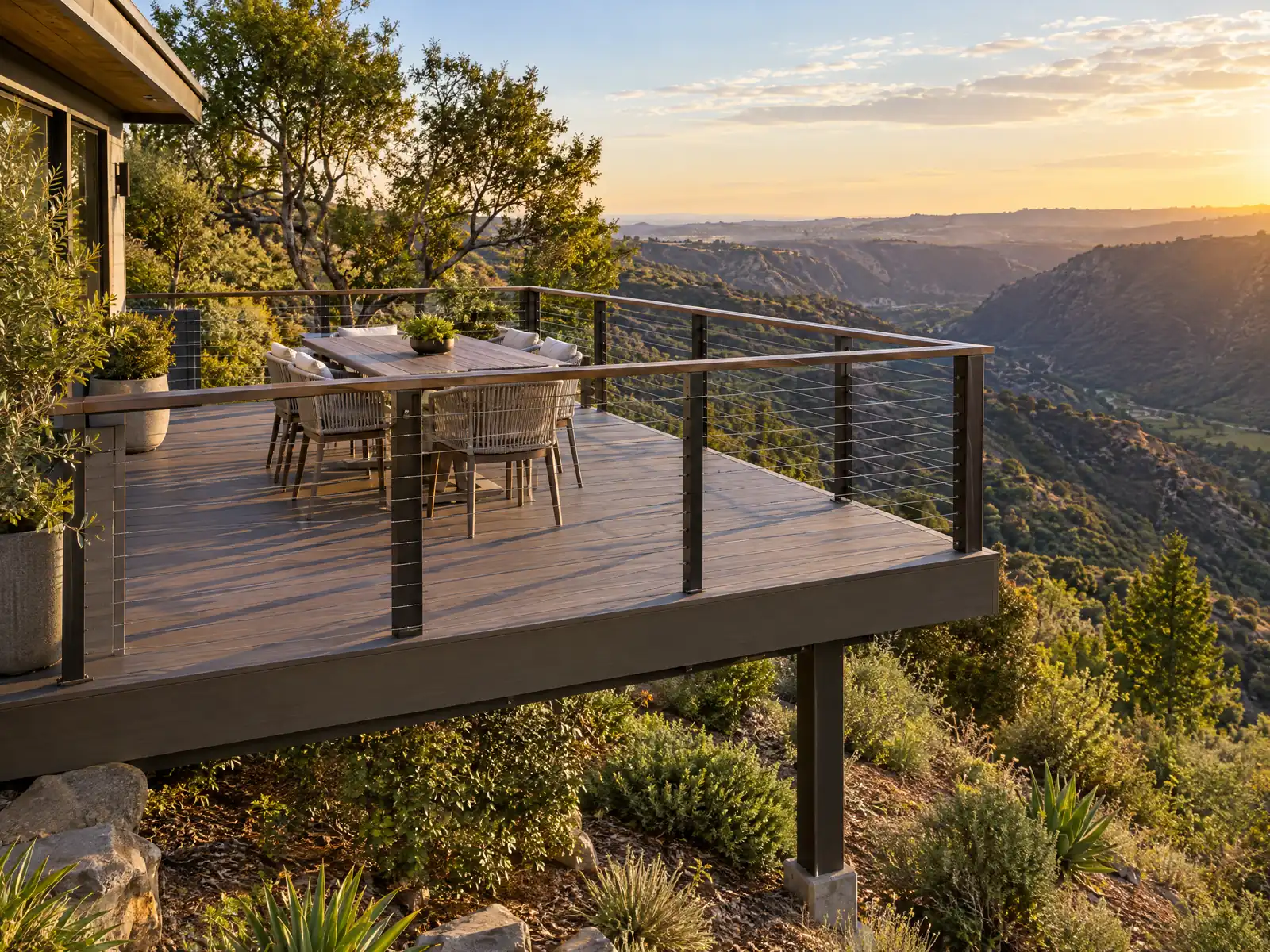
Wood and composite decks, hillside decks and stairs, with permits and code checked before framing.
See deck building →
Painting
Interior, exterior, stucco and cabinet painting with real prep, lead-safe rules followed and a written scope.
See painting →
Windows
Replacement windows and sliding doors, with the LADBS permit path, glass ratings and sourced prices explained.
See window replacement →Keep reading
Do You Need a Permit to Build a Deck in Los Angeles?
The 30-inch rule in the Los Angeles code, how far a deck may reach into a yard, and what inspectors check at the ledger, footings and guard.
Read the guide →Hillside Deck Rules in Los Angeles: Zoning, Soils Reports, Fire Zones and Engineering
What changes when a deck goes on a Los Angeles slope: yard limits, retaining wall counts, soils and geology work, and fire-zone materials.
Read the guide →Stamped Concrete or Pavers: Which Is Better for a California Yard?
Stamped concrete and pavers compared on installed price, repairs, sealing, drainage and clay soil, with dated Los Angeles numbers.
Read the guide →Ready to plan your project?
Call or send the form. We schedule a site visit and send a written proposal.