
SB 9 Lot Splits and Duplexes in Southern California: What Is Allowed?
SB 9 lets the owner of an eligible single-family lot build two primary homes, split the lot into two parcels, or do both, with staff-level approval and no public hearing. Each home may be at least 800 square feet, side and rear setbacks cannot exceed four feet, and a lot split requires a three-year owner-occupancy affidavit.
What does SB 9 allow on a single-family lot?
Senate Bill 9 took effect January 1, 2022 and wrote two tools into the Government Code. Section 65852.21 covers a housing development of no more than two residential units in a single-family zone. Section 66411.7 covers an urban lot split, which turns one parcel into two. An owner can use either, or both.
Both are ministerial. The city checks the application against written standards, with no hearing and no discretionary review. Under the text as last amended effective June 30, 2026, the agency has 60 days from a complete application to approve or deny, the application is deemed approved if it does neither, and a denial has to come with a full written list of defects and how to fix them.
Which lots qualify for SB 9, and which are shut out?
The Department of Housing and Community Development's SB 9 fact sheet, dated September 2024, and the statute set the tests. A lot has to pass all of them.
- It sits in a single-family residential zone. Multifamily, commercial and mixed-use zones are outside the law even where houses are allowed.
- It is in a city that includes part of a Census urbanized area or urban cluster, or wholly inside one if unincorporated.
- The project does not demolish or alter housing with affordability covenants, rent or price control, or a tenant in the last three years.
- No owner used the Ellis Act to withdraw rentals from the parcel in the past 15 years.
- It is not a designated landmark, and the project is not a contributing structure in a historic district.
- It is clear of the environmental site constraints the law borrows from SB 35: HCD lists farmland, wetlands, fire hazard areas, earthquake hazard areas, flood risk areas, conservation areas and wildlife habitat.
How small can the two parcels be after an urban lot split?
Two numbers in section 66411.7 control the geometry. The parcels must be roughly equal, and neither may be smaller than 40 percent of the original lot. Each must also be at least 1,200 square feet unless the city adopts a smaller minimum by ordinance.
A parcel can be split this way once. A lot created by an SB 9 split cannot be split again under the section, and an owner, or anyone acting in concert with the owner, cannot use it on the lot next door after splitting the first.
A worked example: splitting a 6,000 square foot lot
Take a 6,000 square foot lot with one house. The smaller parcel must be at least 6,000 x 0.40 = 2,400 square feet, which leaves 6,000 - 2,400 = 3,600 for the other. Any division from 2,400 and 3,600 to 3,000 and 3,000 fits the rule, and both halves clear the 1,200 square foot floor.
A city does not have to allow more than two units on each new parcel, and that count includes any ADU or junior ADU. So the ceiling is 2 x 2 = 4 homes where one stood. The law also bars local standards that would squeeze a unit below 800 square feet, so the protected floor area is 4 x 800 = 3,200 square feet across the four.
Whether four homes physically fit is a design question: driveways, the four-foot setbacks, required parking and utility runs all take land.
What can a city still require of an SB 9 project?
Cities keep their objective zoning, subdivision and design standards, as long as those do not physically prevent two units of at least 800 square feet. Inside that limit, the statute sets these terms:
- Setbacks: no more than four feet from side and rear lot lines, and none for an existing structure or one rebuilt in the same place and size.
- Parking: up to one off-street space per unit, and none within a half mile walk of a high-quality transit corridor or major transit stop, or when a car share vehicle is within one block.
- Rentals: every unit must be rented for terms longer than 30 days, so no short-term rentals.
- Owner occupancy: for a lot split only, the applicant signs an affidavit of intent to live in one of the homes as a principal residence for at least three years. Cities may not add other owner-occupancy rules.
- Use: lots created by a split are limited to residential uses.
- Denial: only on a written finding by the building official of a specific, adverse health and safety impact that cannot be mitigated.
How does SB 9 work in Los Angeles and nearby cities?
In the City of Los Angeles, the two tools go to different counters. The LADBS SB 9 page says two-unit applications are submitted to LADBS for plan check, urban lot splits are filed with City Planning, and an eligibility checklist for any address is on ZIMAS. City Planning's lot split form asks for a preliminary parcel map stamped by the LADBS Grading Division and a protected tree report, plus a geology and soils report in hillside areas. It also notes that SB 9 units pay development impact fees such as school, park and linkage fees.
In unincorporated Los Angeles County, the Regional Planning SB 9 summary, revised January 7, 2026, limits projects to R-1 and R-A zones and excludes any parcel in the Coastal Zone.
Fire zones need a separate check. The County summary allows a parcel in a Very High Fire Hazard Severity Zone only if all structures meet current fire mitigation standards and the site is outside the Palisades and Eaton fire boundaries. The Governor's Executive Order N-32-25, signed July 30, 2025, suspended SB 9 in those burn areas' very high zones and let local agencies set their own rules there. The Mayor's Emergency Executive Order 9 followed: the City will not accept SB 9 applications in that zone within the Palisades Fire area.
Charter cities add a legal wrinkle. Redondo Beach, Carson, Torrance and Whittier sued the state in 2022, and a Los Angeles Superior Court judge sided with them in April 2024. The Palo Alto Daily Post reports that the Court of Appeal sent the case back for a new look after the Legislature amended the law. If your lot is in Redondo Beach, Torrance, Carson or Whittier, ask the planning counter how it handles applications today.
SB 9 duplex, ADU or addition: which fits your lot?
SB 9 creates primary homes, and a lot split creates a second parcel that has its own title. An ADU stays tied to the main house and cannot be sold apart from it except in narrow cases, but it needs no owner-occupancy affidavit and smaller units get fee relief, as our guide to ADU impact fees explains. The ADU setback and height rules apply statewide as well.
If you simply need more space for your own household, a room addition avoids the subdivision process entirely. Our comparison of a room addition vs ADU covers that choice.
What does building an SB 9 project involve?
It is new home construction, with a subdivision in front of it if you split. A lot split starts with a parcel map from a licensed surveyor or civil engineer. Each new home then needs its own plans, plan check, foundation, utility connections and inspections.
MDG Builders, CSLB #1040337, takes these on as a general contractor. We line up the design team, shepherd the applications and schedule the build, and licensed subcontractors handle the concrete foundations, framing, roofing, plumbing and electrical. Ask us for any subcontractor's license number and insurance certificate before work begins.
SB 9 questions
Can I split my lot under SB 9?
Yes, if the lot is in a single-family zone in an urbanized area and passes the law's exclusions for historic sites, tenant-occupied or rent-restricted housing and environmental hazards. Each new parcel must be at least 40 percent of the original and at least 1,200 square feet.
Do I have to live on the property to use SB 9?
Only for a lot split. The applicant must sign an affidavit stating an intent to occupy one of the homes as a principal residence for at least three years from approval. Building two units on an unsplit lot carries no owner-occupancy rule, and cities cannot add one.
How many units can I build on a single-family lot with SB 9?
Up to four in most cases. After a lot split, a city must allow two units on each new parcel, counting ADUs and junior ADUs. Without a split, you may build two primary units and add ADUs under ADU law, but HCD says no city is required to allow more than four units on one lot.
Can I use SB 9 in a fire hazard zone?
Sometimes. HCD lists fire hazard areas among the site conditions that can disqualify a lot, and Los Angeles County allows very high fire zone parcels only when structures meet current fire mitigation standards. In the Palisades and Eaton burn areas, a 2025 executive order let local governments block SB 9, and the City of Los Angeles did so for the Palisades.
Can I rent an SB 9 unit on Airbnb?
No. Both SB 9 sections say a local agency shall require that any unit created under them be rented for a term longer than 30 days. That rules out nightly and weekly stays. Month-to-month and longer leases are fine.
Can I sell one of the lots after an SB 9 split?
The split creates two legal parcels, and we found nothing in section 66411.7 that bars selling one. The owner-occupancy affidavit is the catch: you declared an intent to live in one of the homes for three years. Talk to a real estate attorney before listing either parcel early.
Work that goes with this
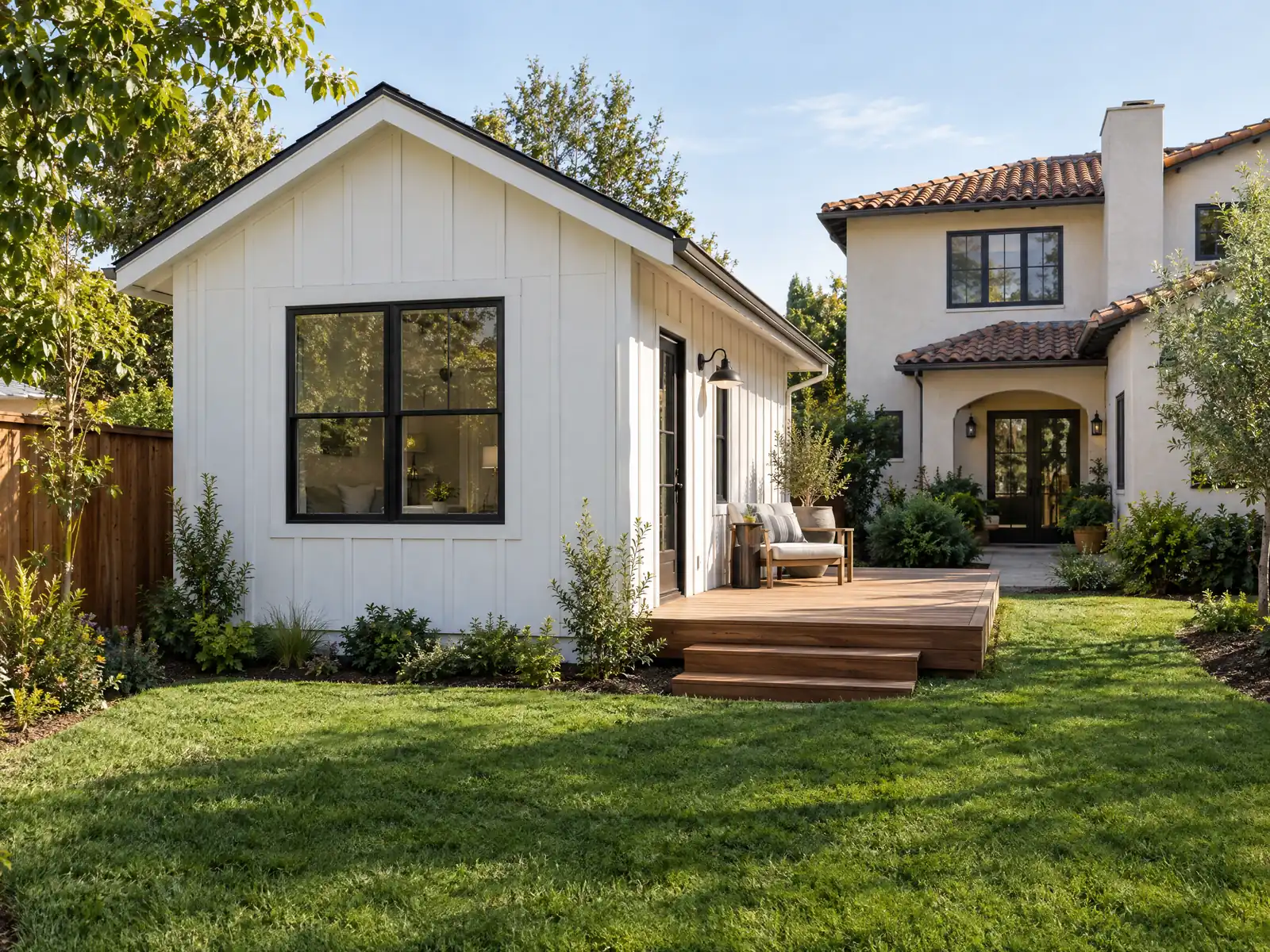
ADU Construction
Garage conversions, detached ADUs and JADUs, with the 2026 permit clocks, utilities and sourced costs explained.
See ADU construction →
Room Additions
Family rooms, primary suites and second stories, from zoning check to final inspection, with sourced prices.
See room additions →
Concrete
Patios, driveways, walkways and retaining walls, poured by licensed specialists and priced from sources.
See concrete work →Keep reading
How Close to the Property Line Can You Build an ADU in California?
The 4-foot side and rear rule, the 16, 18 and 25 foot height floors, the size caps a city cannot go below, and a lot-fit example.
Read the guide →Can You Rent Out an ADU in California? Owner Occupancy and Short-Term Rules
State law on ADU owner occupancy and 30-day minimums, Airbnb limits in Los Angeles and San Diego, and how rent control treats a new unit.
Read the guide →
Room Addition vs ADU: Which Should You Build?
Cost, permits, rules and income compared for a Los Angeles homeowner choosing between building onto the house and building a second unit.
Read the guide →Ready to plan your project?
Call or send the form. We schedule a site visit and send a written proposal.